The “Two Cultures” discussion and debate, between Neil Postman and Camille Paglia, zeroes in on two separate forms of media present today: Television and Written Word; Postman standing with the Written, and Paglia with TV. The debate gets rolling with the topic of early Christianity, and the necessity of images in the early church. From here, a slight bickering continues as they move to related topics of TV and literature.
To be honest, I felt as if I was reading a political debate gone wrong. Both arguments do not emphasize any positives of either medium. Instead, Postman and Paglia simply poke holes in the others preference.
From an opinionated standpoint, I agree that there are weaknesses in both mediums, but I also feel there are significant strengths also. TV has the advantage of pulling in several aspects of art into itself. In addition to the visual, there is the heavy bonus of audio. The sound and music adds a good deal of ‘attention grabbing’ material to the medium. But at the same hand, TV cannot hold depth as easily as literature can.
I don’t think Postman and Paglia did justice to either medium in their debate. If I would agree with any statement wholeheartedly it would be Paglia’s reference to how messages are stronger in the written texts because their emphasis is on that message and not on picture and sound. But regardless of the message, the future of media as a whole is through the integration of visual and audio mediums. Literature has been on a significant downward slope for quite a bit of time, and will continue down, whereas TV has been steadily heading up. TV has also been taking on more cinematic style in several shows, which contributes to the “reality” of the medium, which also pulls viewers in even further.
I don’t think either TV or Literature can take full superiority over the other. Both have their unique strengths and weakenesses.
Tuesday, December 11, 2007

Friday, December 7, 2007
Dropping the Pencil

The Current Questions of TIME:
How much is content worth in the digital age?
Is content really worth something to the media consumer?
ANSWER - Content is worth quite a bit in the digital age. Now, although some may argue that traditional, whole hearted 'content' is fleeting (to which they would be correct about), does not make content as a whole worthless. It merely depends on what the content is, how it is presented, and what it is intended to deliver. Clever writers will keep up and deliver what the general public wants to see. Reality TV is dying. Aside from MTV, the general public is beginning to get its fill. People are waking up. It is a 'media phase.' More traditional programming, however, such as "Heroes," has been around since the birth of television. And considering the attention spans of the average American TV views re-runs are not going to suffice.
"...the networks and studios are making the depressing bet that "quality" — i.e., original scripts — doesn't matter that much to the market. But who's to say they're wrong? Media consumers are deluged with diversions, many of them free. Even the New York Times couldn't get enough subscribers to sustain a paid online-subscription plan..."
~Time
The networks are making the wrong bet: that they don't need them, and that hoping the writers will bend and come back is inevitable.
It is logical that the writers are thinking about their future. Entertainment is changing, and they're smart to want to change with it.
"...the producers and writers continue playing chicken on a railroad track, with you as the oncoming train. Maybe they'll be right after all, and at the end of the strike, the nation will fall in love with TV all over again. And if they're wrong? Well, there's always Break.com..."
~Time
I brought this topic up in a coffee house this past week. Several of my friends didn't quite understand why and what this, and any other strike for that matter, was about. I had to explain that it's still one of the few very American things we hold on to. These writers see change coming, they want to prepare and make sure they get what's fair. The networks are thinking dollar signs. But it's not like that is a new concept.
Who should be looking for the solution? The networks should find a solution. Since I'm not a financial expert, I can't say what that might be. But I think the writers should be given more credit for the work they produce. Most mainstream entertainment as we know it comes from these guys. And to push them to the side is really slapping the consumer in the face.
I also really want to see "Gigli 2." And that's just not going to happen with the strike.
Sunday, November 25, 2007
Switching Off to Switch On
Thursday, Thanksgiving
The 22nd of November
The 22nd of November
Let's Wear a Media Hoodie
I pulled myself out of bed at around 9:30, and made my first move towards the cell phone resting on my dresser. Stretching, I brought up the screen. One new text message from my younger brother, who was asleep in the next room. I laughed, reading. "So, today's that day, Stef. Good luck. I call the Xbox. And the computer. And the TV." I sighed, and held on to the power button. "Alright," I thought to myself, "Let's see how this turns out."

The morning wasn't really much of an issue. I spent most all of it in the kitchen with my Mom and cousins visiting from Italy. And may I just say, thank God they were in town. If it wasn't for them, I would have probably blatantly failed in my efforts of deprivation.
For example, my first big obstacle hit while in the car driving to Thanksgiving dinner at my Aunt's house. Normally, the radio is blasting, and everyone is enjoying the music during the car ride. But due to the fact that my cousins were in town, no one touched the radio. It was all conversation. And that conversation continued for most of the night. Before dinner, I just had to make an effort to avoid the football my uncles were watching. Thank God it wasn't soccer. Because to an Italian family, ignoring an important Italia soccer game could be punishable by excommunication, or a deprivation of food. And to an Italian, both are unthinkable.
Now, to the exciting portion of my story: My failure. May I point out that it was completely unintentional, but nevertheless, happened. In my defense, it was late, and since the tryptophan in turkey is known to have a tiring effect, I'm basically innocent... Ok, so, I watched my cousin play "Assassin's Creed" on his PS3 after dinner. And I didn't realize I had broken until the next morning. I woke up, quite refreshed. I rolled over, and turned on my phone thinking I had triumphed. "That wasn't too bad," I said to myself with another stretch. My phone powered up, and immediately buzzed with a new text message. It was from my cousin. "Hey, Stefan! What'd you think of Assassin's Creed?!"
Great.
So, I came close. Thinking about some of the students mentioned in "The Longest Day," from the Washington Post, I can relate to how some enjoyed the break, but at the same time had difficulty maintaining it for a full 24 hour period. I agree that we have "over-media medicated ourselves." My main source of news is the Internet, not newspapers. Yet on a counter point, my main source of entertainment is my guitar, not TV, gaming, or Internet.
As long as I consciously avoided media, it wasn't too hard. But the fact that I broke the fast and didn't even notice until the following day shows how much modern media is intertwined into our everyday lives.
We're media junkies. And we love it.
Sunday, October 21, 2007
Oki Doki Moki Poki, Quickie Sticky Slicky Wiki
BOOM!!!
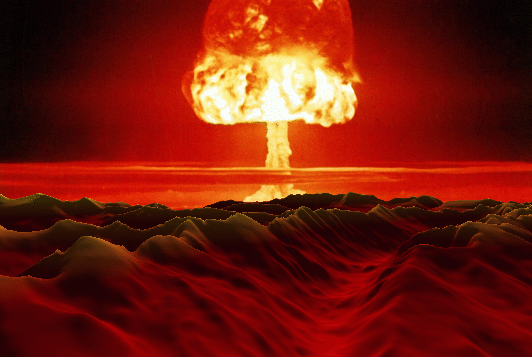 Above: Large Nuclear Explosion
Purpose: Attention Grabber
.
BLOG ~ THE DISCOVERY BLOG
.
.
Firing some basic points of the blog: It covers both political and moral issues, doing a FANTASTIC job at avoiding most all "Entertainment Tonight" related stories. *phew*
.
The Positives and The Negatives about this blog:
- For the most part, stays focused in a neutral political stance. HOW? It featues entries from both right wing, left wing, and the most seperated green wing parties. However, this gives a hard beat to follow. Each article stands on its own, and continuity can be tough to find.
- Great scientific updates on science issues around the globe. But at times, scientific data is not the only part of the equation to a whole story, and, therefore, these atricles do not tend to present the whole story.
- Great links to other reliable sources, both scientific and political.
.
The Blog goes recommended to those of the reasoning middle ground. Due to both sides, a reader must be able to discern truth, and know how to click on to further the truth in knowledge they're gaining!
So, party extremists! Stay out!
Flashier readers! This isn't going to do it for you! And please, accept apologies for luring you here due to the nuclear explosion captured at the top of the blog!
Britney fans! This isn't going to work for you either!
Everyone else, welcome in. Enjoy your stay. And take something worth passing on from your read.
Sunday, October 14, 2007
From Chisel to Quill: A Writing Revolution
Since the first recorded writing system from ancient Mesopotamia, cultures have adopted literacy in its many different forms in application to daily life, economy, and entertainment. Making a distinct progression over time, the technological jumps in the writing world have changed it accordingly. One to duly note is the invention of papyrus and paper, and the impact that these discoveries had on the way things were recorded and written, the style in which this was done, and also the availability of literacy to the cultures affected. It’s quite a jump from hammer to quill.
Pre-literate society gets a bad reputation more times than not. But when a perspective of oral culture is taken on, though, things do change. Before the discoveries were made, stories, trades, and an abundance of knowledge needed to be remembered, since there was no means to record. This meant that one generation passes its experience and the experience of the generations prior to the next generation coming up. Once the vastness of all that cumulative knowledge is realized, it’s easy to see how some slipped through the cracks. It’s understandable that the content of stories and tales changed progressively over time. Even with the invention of basic stone and clay tablet writing systems, the majority of writing was done in relation to government, law or commerce.
When more standardized recording methods came about, the oral culture diminished. This leads to two distinct changes in culture: Less demand on human memory, and a much higher demand on recorded knowledge. Some could argue that this was a negative. That writing was detrimental to memory. But as far as a wealth of knowledge is concerned, literacy allows for massive amounts of information to be recorded, and re-visited when needed.
“Papyrus was for nearly a thousand years the main writing material of the Greco-Roman world. First manufactured in Egypt as far back as the third millennium B.C., it was prepared from the papyrus, an aquatic plant formerly plentiful in that country, though now extinct there… Papyrus was exported to Greece and there used for both literary works and business documents certainly as early as the fifth century B.C. and probably much earlier. Its use spread throughout the whole Mediterranean world, but it was naturally most general and most persistent in Egypt, the country of origin.”
Pre-literate society gets a bad reputation more times than not. But when a perspective of oral culture is taken on, though, things do change. Before the discoveries were made, stories, trades, and an abundance of knowledge needed to be remembered, since there was no means to record. This meant that one generation passes its experience and the experience of the generations prior to the next generation coming up. Once the vastness of all that cumulative knowledge is realized, it’s easy to see how some slipped through the cracks. It’s understandable that the content of stories and tales changed progressively over time. Even with the invention of basic stone and clay tablet writing systems, the majority of writing was done in relation to government, law or commerce.
When more standardized recording methods came about, the oral culture diminished. This leads to two distinct changes in culture: Less demand on human memory, and a much higher demand on recorded knowledge. Some could argue that this was a negative. That writing was detrimental to memory. But as far as a wealth of knowledge is concerned, literacy allows for massive amounts of information to be recorded, and re-visited when needed.
“Papyrus was for nearly a thousand years the main writing material of the Greco-Roman world. First manufactured in Egypt as far back as the third millennium B.C., it was prepared from the papyrus, an aquatic plant formerly plentiful in that country, though now extinct there… Papyrus was exported to Greece and there used for both literary works and business documents certainly as early as the fifth century B.C. and probably much earlier. Its use spread throughout the whole Mediterranean world, but it was naturally most general and most persistent in Egypt, the country of origin.”

This new canvas brought several things along with its invention. Due to the portability and ease of writing on the Papyrus, literacy was able to spread beyond the scribes and made an entry to the general populations. With recording now done with quills or a sort, as opposed to chisels and stone, more liberal characters, as well as more rapid writing, came about. Over time, alphabets replace symbols and hieroglyphics, and from there, more detailed texts emerge.
Paper and Papyrus took on many uses once fully integrated into society. In the beginning, it assimilated similar uses to its clay and stone predecessor: Used for recording trade and governmental business. As time moved forward, it finds uses in entertainment, personal correspondence, and political spinning. From its discovery on, progress is continually made. The wealth of knowledge is collected from around the globe, and distributed in libraries such as the Library at Alexandria. Without paper and papyrus, the only knowledge we would have of the ancient world would be via oral culture or symbolic stone writings. Those methods would give us a vague idea of the cultures that preceded us, but by no means would they provide the window we have today due to the texts that have been preserved over time. The writings and thoughts of the ancient philosophers, the medical and engineering feats of Rome, and histories recorded would all be, for the most, lost. Just look at what happened during the lack of literacy and communication during the Middle Ages after the fall of the Roman Empire. Ouch. Literate culture definitely takes the win.
Literacy through the creation papyrus and paper changed the world. Allowing for knowledge to be accumulated, great civilizations were able to spring up and move forward technologically; Civilizations that have shaped the world we live in today. Without those discoveries, for all we know, the saying ‘chiseling out a paper’ would take on a whole new meaning.
Reference:
H. Idris Bell and T.C. Skeat, 1935. "Papyrus and its uses"
David Crowley and Paul Heyer, 2007. “Communication in History”
Tuesday, September 18, 2007
Growing up in double click communication

For as long as I can remember, digital communication has been a huge part of the culture I've been engulfed into; Emails when I was a todler, instant messaging and xanga in middle school, facebook and myspace in high school, and the ever present text messaging.
I had a really interesting conversation with a close friend of mine this past week on the topic of digital communication. He, being a few years older than I, was relating how the progression of technology that has developed has impacted how differently each generation communicates, and how the "generational gaps" have gotten so much smaller with these new emerging technologies.
Although he is only a few years older, he is still in a completely different means of communicating than I am accustomed to. For example: Take blogging. He does it. Religiously. I don't, never have, and probably will not continue to do so after these assignments. Why? Because it's not a media form that was introduced to me in the same way it was introduced to him. He relies mostly on emails to keep in touch with friends around the country. What do I use? Facebook. Although the technologies are similar, they contrast with large differences, and, once again, timing.
The more I thought about this, the more amazed I was. If the pattern continues, we will always be a step behind the technological hop. And not because we're not 'tuned in' or 'technically apt,' but because the media has age groups in crosshairs, and when we're not part of those targeted groups, the product is going to have the tendancy to jump over our heads.
Wednesday, September 12, 2007
Sunday, September 9, 2007
Stefan: An Introduction

I guess I'm a rookie at this. I spend most of my creative expression writing songs and music, enough so that this more narrative side is a little strangle. Well, reguardless, I'm going to give it shot. Probably a very inaccurate, lobbed shot, but a shot nonetheless!
Let's see. Where would be a smart place to kick this off on? Well, the biggest part of my life is probably that which has already been stated. I'm a musician. I spend most all of my time with my guitar, or singing, or in front of my piano, or with a pen and a stack of sheet music in front of me. OR! If I'm feeling really ambitious: All of those things at the same time. I love the blues, R&B, classic rock, jazz, and rock & roll as a whole. Music moves me.
You combine that with my love for film, gaming, and other media-related topics, and you find what has started me on my current achademic path. I wanted to understand from every point of view that I could. I wanted to dive into culture, expression, and development. To put it simply, it just pushes the right buttons.
I guess another reason I probably enjoy those topics so much is due to my background. I come from a very big, loud, and loving Italian family. A family that loves both the arts and its achademic counterpart.
Along with those interests, I do love to cook, dance, play a nice, wide variety of sports, and have a passion in disliking most country music =) I do mean that in the nicest way possible. But as a classically trained musician, can you blame me?
With any questions, comments, or cookie recipies, you can always shoot me an email! StefanKempski@gmail.com
~Stefan
Subscribe to:
Comments (Atom)
